54k people like this.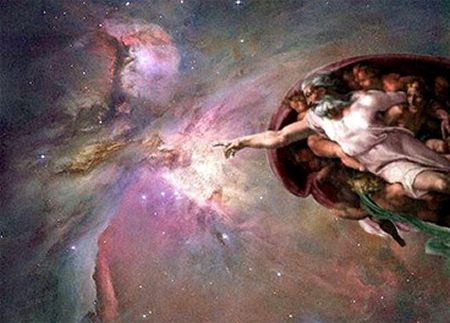
Religion and science look at reality differently. One day we found ourselves alive and aware and, around age two an ongoing memory track started recording selective inputs. In fact, years ago I carried out experiments with noted Harvard Psychologist B.F. Skinner (Science, 1981) that showed even animals are capable of “self-awareness.” At some point in childhood most people ask themselves, “Hey! What IS this place?” It isn’t enough for us to just be aware. We want to know why existence is the way it is.
Both science and religion appear to be honing in on a deeper reality, one totally ignored by most people until now.
As children we were bombarded by competing answers. Church says one thing, school another. Now as adults it’s no surprise that if we discuss the nature of it all, we generally spout some combination of the two, depending on our individual inclination and mood.
We may struggle with attempts at merging science and religion, when, for instance, we watch the Christmas planetarium show “Star of Wonder,” which purports to find logical explanations for the Star of Bethlehem. This is also seen in such bestselling books as The Tao of Physics and the Dancing Wu-Lei Masters, which purport to show that modern physics says the same thing as Buddhism.
However, such efforts are futile, even if they’re popular. Physicists insist the Tao of Physics doesn’t talk about the actual science, but an unrecognizable flower-child version. The annual planetarium Christmas presentations, for their part, dishonor both religion and astronomy, since the directors know that no object in the sky, whether comet or planet, can come to a screeching halt over Bethlehem. Bottom line: None of the explanations work, but such shows have been well-attended holiday traditions. Meanwhile, on the religious side, those who take the “star” story literally are being told that no miracle unfolded; it was merely a conjunction of planets that happened at just the right time.
Classic Science’s Basic Take on the Cosmos:
Everything started 13.7 billion years ago when the entire universe materialized out of nothingness. All structures and events are created entirely randomly, given the four fundamental forces and a host of other parameters. Life began 3.9 billion years ago on Earth, and possibly elsewhere at unknown times. It too occurred by the random collisions of molecules, which in turn are made of combinations of the 92 natural elements. Consciousness or awareness arose out of life in a manner that remains mysterious.
Classic Science’s Answers to Basic Questions:
How did the Big Bang happen? A: Unknown
What if anything existed before the Big Bang? A: Unknown
How did life arise? A: Unknown
What is the nature of consciousness? A: Unknown
Why are the forces & constants the way they are? A: Unknown
Is life experienced after one’s body dies? A: Unknown
Okay, so what can science tell us? A lot. Libraries full of knowledge. All of it has to do with classifications and sub-classifications of all manner of objects, and how processes work such as how stars are born and how viruses replicate. In short, science seeks to discover the properties and processes within the cosmos. How to form metals into bridges, how to build an airplane, how to perform surgery — science is peerless at things that make everyday life easier.
So those who ask science for ultimate answers, or to explain the fundamentals of existence, are looking in the wrong place — like asking particle physics to evaluate art. Scientists don’t admit this. However, some branches of science act as if science can indeed provide answers in the deepest bedrock areas of inquiry. We say, “Go ahead, give it a go.” But thus far, it has had little success.
Religion’s Take on the Cosmos:
There are many religions, and we can’t get into their endless distinctions here. But two general schools exist, each with billions of adherents. They are so oceanically distinct in outlook and stated goals, they must be treated separately:
Western Religions (Christianity, Judaism, Islam):
The Universe is entirely a creation of God, who stands apart from it. It had a distinct birth date and will have an end. Life was also created by God. The most critical purposes of life are twofold, to have faith in God, and to be obedient to God’s rules such as the Ten Commandments, and other rules as outlined in the Bible or the Koran. God is omnipotent and omnipresent, the creator and sustainer of the universe. No mention is made of consciousness.
Western Religion’s Answers to Basic Questions:
How did God arise? A: Unknown
Is God eternal? A: Yes
What came before the Big Bang? A: Not relevant (God created everything)
What is the nature of consciousness? A: Not discussed; unknown
Is life experienced after one’s body dies? A: Yes
Eastern Religions (Buddhism and Hinduism):
All is fundamentally One. The true nature of reality is existence, consciousness and bliss. Appearance of individual separate forms is illusory. The One is eternal, perfect, and operates effortlessly. Time is illusory. Life is eternal; most sects believe this operates through reincarnation. The goal of life is to perceive cosmic truth by losing the false sense of illusion and separateness.
Eastern Religions’ Answers to Basic Questions:
What was the Big Bang? A: Irrelevant. Time doesn’t exist; the universe is eternal
What is the nature of consciousness? A: Unknowable through logic
Does life persist after the body dies? A: Yes
Biocentric Take on the Cosmos:
There’s no separate physical universe outside of life and consciousness. Nothing is real that isn’t perceived. There was never a time when an external, dumb, physical universe existed, or that life sprang randomly from it at a later date. Space and time exist only as constructs of the mind. Experiments in which the observer influences the outcome are easily explainable by the interrelatedness of consciousness and the physical universe. Neither nature nor mind are unreal, both are correlative. No position is taken regarding God.
Biocentrism’s Answers to Basic Questions:
What created the Big Bang? A: No ‘dead’ universe ever existed outside of mind (“Nothingness” is a meaningless concept)
Which came first, rocks or life? A: Time is a form of animal intuition
What IS this universe? A: An active life-based process
This is reflected in the seven principles of biocentrism:
1st Principle: What we perceive as reality is a process that involves our consciousness.
2nd Principle: Our external and internal perceptions are inextricably intertwined. They are different sides of the same coin and can’t be divorced from one another.
3rd Principle: The behavior of matter is inextricably linked to the presence of an observer.
4th Principle: Without consciousness, “matter” dwells in an undetermined state of probability.
5th Principle: The structure of the universe is explainable only through biocentrism. It’s fine-tuned for life; life creates the universe, not the other way around.
6th Principle: Time doesn’t have a real existence outside of animal intuition.
7th Principle: Space, like time, isn’t an object or thing that has an independent reality.
Looking back over the various world views, it’s clear that biocentrism, classic science and religions have distinctly different answers to the big questions. On the other hand, quantum physics and biocentrism have similarities to some of the tenets of Eastern religions as well. Both science and religion appear to be honing in on a deeper reality, one totally ignored by most people until now.
Co-authored with Bob Berman
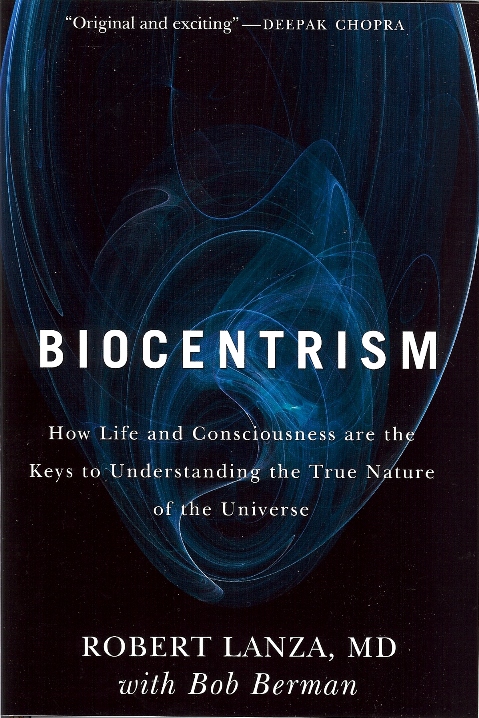
Adapted from Biocentrism
“Biocentrism” (BenBella Books) lays out Lanza’s theory of everything.