We’ve been taught our consciousness — and everything else in the world — flows like an arrow in one direction from the cradle to the grave. But an amazing set of experiments suggest the present and the future are entangled, and that events in the future may influence things happening in the world now.
Since this sounds absurd, let’s go straight to an actual experiment published in 2002. Scientists showed that pairs of particles could anticipate what their distant twins would do in the future. They stretched the distance one of the photons took to reach its detector, so the other photon would hit its own detector first. The photons taking this path already finished their journeys — they either collapse into a particle or don’t before their twin encounters a scrambling device. They decided this before their twin ever encountered the scrambler. Somehow, the particles “knew” what the researcher would do before it happened.
We, of course, live in the same world. Does this experiment suggest your unborn child could influence what’s going on next to you right now?
In the mid-30’s, physicist Erwin Schrödinger, upset about the implications of quantum theory devised a thought experiment to try to reveal the absurdity of applying quantum reality to the ordinary world. He imagined a closed box containing a cat and a radioactive source. If a detector registers a radioactive particle, a poison gas is released and the cat dies; if not, the cat lives. The detector is turned on so there’s a 50-50 chance the radioactive source will emit a particle. If quantum reality is applied to this experiment, neither of the possibilities open to the radioactive source, and therefore to the cat, has any reality unless its observed; that is, the atomic decay has neither happened nor not happened, and the cat is neither dead nor alive until we look inside the box to observe it. One might say the cat exists in an indeterminate state until it’s observed.
Ironically, although Schrödinger devised this experiment to reveal the absurdity of applying quantum notions to the everyday world, many scientists believe Schrödinger’s conclusion is an appropriate analysis of the cat’s (or our) predicament. Some object on the grounds it’s non-deterministic — Einstein’s quotes “God does not play dice” and “Do you really think the moon isn’t there if you aren’t looking at it?” exemplify this. In response, the great Nobel laureate, Niels Bohr said “Einstein, don’t tell God what to do.”
Recent experiments suggest Schrödinger’s “absurd” conclusion may be right. Zeilinger’s work with huge molecules called buckyballs pushes quantum reality into the macroscopic world. In an exciting extension of this work — proposed by Roger Penrose, the renowned Oxford physicist — not just light, but a small mirror that reflects it, becomes part of an entangled quantum system, one that’s billions of times larger than a buckyball. If the proposed experiment confirms Penrose’s idea, it would furnish the most powerful evidence that biocentrism — that is, the biocentric view of the universe — is correct at the level of living organisms.
In a 2007 experiment, scientists shot photons into an apparatus and showed they could retroactively change whether they behaved as particles or waves. The particles had to “decide” what to do when they passed a fork in the apparatus. Later on, the experimenter could flip a switch. It turns out what the observer decided at that point determined how the particle had behaved at the fork in the past.
You may be wondering, “What’s this got to do with me?” Consider a modification of Schrödinger’s experiment. Replace the radioactive source with an entangled particle in the measuring device. If the detector registers a particle, the poison is released and the cat dies. Now put your cat in the box with lots of food and water. By activating a scrambling device in the path of the particle’s twin (like in the 2002 experiment described above), you’d have the power in the future to decide whether or not Paws lived or died in the past.
If biocentrism is correct, future experiments will confirm the world is indeed influenced by the future. The past, present and future are inseparably entangled. Spinoza’s genius sensed this back in the 17th century. To be conscious of space and time, he explained, is to transcend them. The mind transcends space and time in the sense that they’re for it and it’s not in them. Consciousness can’t exist simply in space and time, and at the same time be aware of the interrelations of all parts of space and time. In order to have knowledge of objects, it must somehow be part of them.
Eminent Princeton physicist John Wheeler (who coined “black hole”) insisted when observing light from a distant quasar bent around a galaxy, we’ve set up a quantum observation on an enormously large scale. It means, he said, the measurements made on incoming light now, determines the path it took billions of years ago. This mirrors the results of the actual quantum experiment described above, where an observation now determines what a particle’s twin did in the past.
In 2002, Discover magazine sent a reporter to the coast of Maine to speak to Wheeler firsthand. Wheeler said he was sure the universe was filled with “huge clouds of uncertainty” that haven’t yet interacted either with a conscious observer or even with some lump of inanimate matter. In all these places, he said, the cosmos is “a vast arena containing realms where the past is not yet the past.”
This logic applies not just to events that took place billions of years ago. What you do today could influence past events — say, at the building of the Great Pyramids, the birth and death of Christ, or landing on the moon — or events that will occur millions of years in the future when the Sun’s dome obscures the heavens.
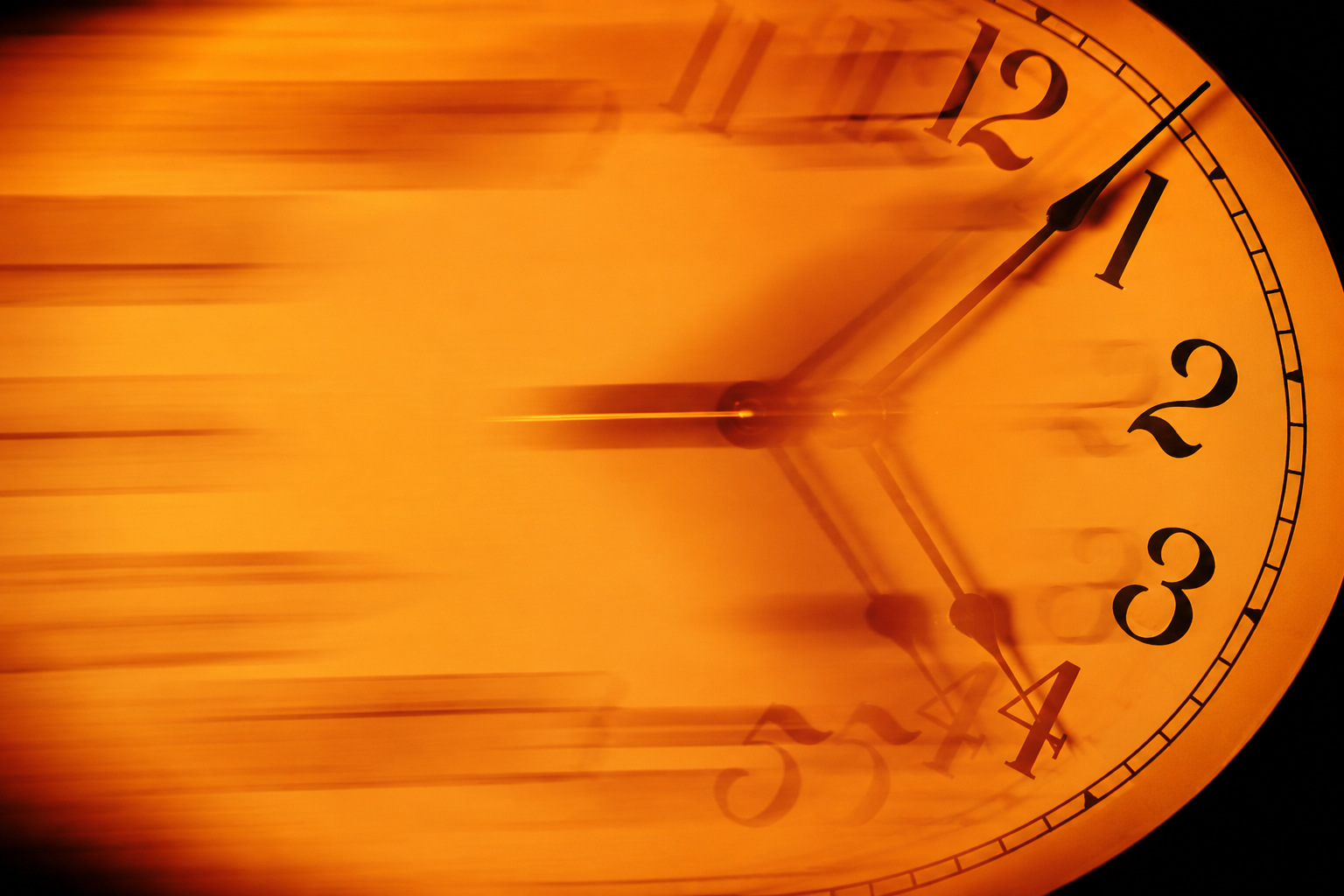
As The Time Traveller in H.G. Wells’s story pointed out, our ideas about time are founded on a misconception.
“The Time Traveller was not there. I seemed to see a ghostly, indistinct figure sitting in a whirling mass of black and brass for a moment… It may be that he swept away into the past…Or did he go forward…?” ( H.G. Wells, The Time Machine)
What would The Time Traveller find? It may depend on what you do after reading this article. And BTW, make sure you don’t let your cat out of your sight.