
Is This All We Are, Is There Nothing More?
We all know the biological reason we age and die. Our bodies break down and are discarded like an old car or a worn-out pair of jeans. No one escapes the ravages of time. Or do they?
The big question is why is the universe this way to begin with? Of all of the possible ways the universe could be structured, why are the laws of nature the way they are? Why do things become less ordered (second law of thermodynamics), rather than more ordered? Why do systems deteriorate — and life die — rather than stay the same?
Equally relevant, is the question of why out of all of existence — out of everything possible in the universe — all you get to be is, say, a plumber or a hairdresser. And that’s it! — followed by nothingness for the rest of eternity. You’ll never get to travel in a spaceship to distant stars, or to live in a world without cancer or war. Scientists say it’s all an accident. If you’re dealt a bad hand, oh well, it’s just tough luck. You’ll die soon enough.
Our inability to comprehend the true nature of life shouldn’t come as a surprise, considering our DNA differs from apes and monkeys by less than 2 percent. We primates — whether scientist or macaque — have significant cognitive limitations. Like a mouse or a gerbil, we open our eyes and the world — as if by magic — is just there. We think it’s a thing, a hard object. But this is inconsistent with hundreds of experiments carried out in the last century.
Reality is observer-determined — it’s a spatio-temporal process, which fortunately, means that things must change. Could you imagine always and forever being a toddler? Diapers and lollipops would grow tiresome. Or forever being a senior? The laws of nature are structured so that we grow and change, and get to experience the full spectrum of biological existence.
That part of the equation is easy to understand: First we experience life as children, then as middle-aged adults, and finally, as senior citizens. But we can’t connect the dots beyond that. You’re a shoe-maker for a few years and then it’s into the void of nothingness forever. Stephen Hawking summed this viewpoint up quite accurately: “I regard the brain as a computer which will stop working when its components fail. There is no heaven or afterlife for broken down computers.”
This is the limit of our primate comprehension. Still, at some point, virtually everyone has wondered: “Is this all we are, is there nothing more?”
Fortunately, there is more. In Immanuel Kant’s “Critique of Pure Reason,” the great philosopher explained how space and time are forms of human intuition. Indeed, everything you see and experience is information in your mind. If space and time are tools of the mind, then we shouldn’t be surprised that at death there’s a break in the connection of time and place. Without consciousness, space and time are meaningless; in reality we can take any time — or any spatial plane — and estimate everything against this new frame of reference.
Death is simply a break in our linear stream of consciousness. Indeed, biocentrism suggests it’s a manifold to all dimensional potentialities (see “What Happens When You Die?”).
Time is the inner sense that animates existence, not just our thoughts and feelings, but the spatial representations we experience from birth until death. It’s just the way we connect things, not an invisible, continuous matrix with people and particles bouncing around in it. Consciousness isn’t created or destroyed — it only changes forms. It’s like a bubble machine that creates spheres — spheres of space and time, which we carry around with us like turtles with shells.
Physics tells us observations can’t be predicted absolutely. Rather, there’s a range of possible observations each with a different probability. According to one interpretation, each of these possible observations corresponds to a different universe (the “multiverse”). There are an infinite number of universes (including our own) that comprise everything that can possibly happen. Thus, death doesn’t exist in any real sense, since all possible universes exist simultaneously regardless of what happens in any of them.
True, you age and die, but there are always bubbles (universes) spanning the breadth of eternity. Some may not travel very far, but others will float off into the horizon. Perhaps you’ll get that space-trip to the stars after all.
“The first step to eternal life,” said Chuck Palahniuk “is you have to die.”
Further Reading
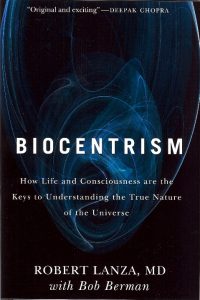
Biocentrism: How Life and Consciousness are the Keys to Understanding the True Nature of the Universe
Biocentrism takes you on a seemingly improbable but ultimately inescapable journey through a foreign universe‒our own‒from the viewpoints of an acclaimed biologist and a leading astronomer. It will shatter your ideas of life-time and space, and even death…you will never see reality the same again.
"Like "A Brief History of Time" it is indeed stimulating and brings biology into the whole. Any short statement does not do justice to such a scholarly work… Most importantly, it makes you think."
—Nobel Prize Winner E. Donnall Thomas
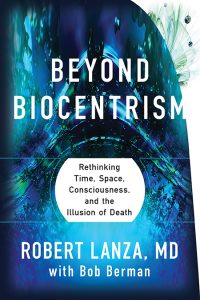
Beyond Biocentrism: Rethinking Time, Space, Consciousness, and the Illusion of Death
"Beyond Biocentrism is an enlightening and fascinating journey that will forever alter your understanding of your own existence."
—Deepak Chopra
"Beyond Biocentrism is a joyride through the history of science and cutting-edge physics, all with a very serious purpose: to find the long-overlooked connection between the conscious self and the universe around us."
—Corey Powell, ex editor-in-chief, Discover magazine
"Will machines ever achieve consciousness? Are plants aware? Is death an illusion? These are some of the big questions tackled in Beyond Biocentrism, which serves up a new, biology-based theory of everything that is as delightful to read as it is fascinating."
—Pamela Weintraub, ex editor-in-chief of OMNI Magazine
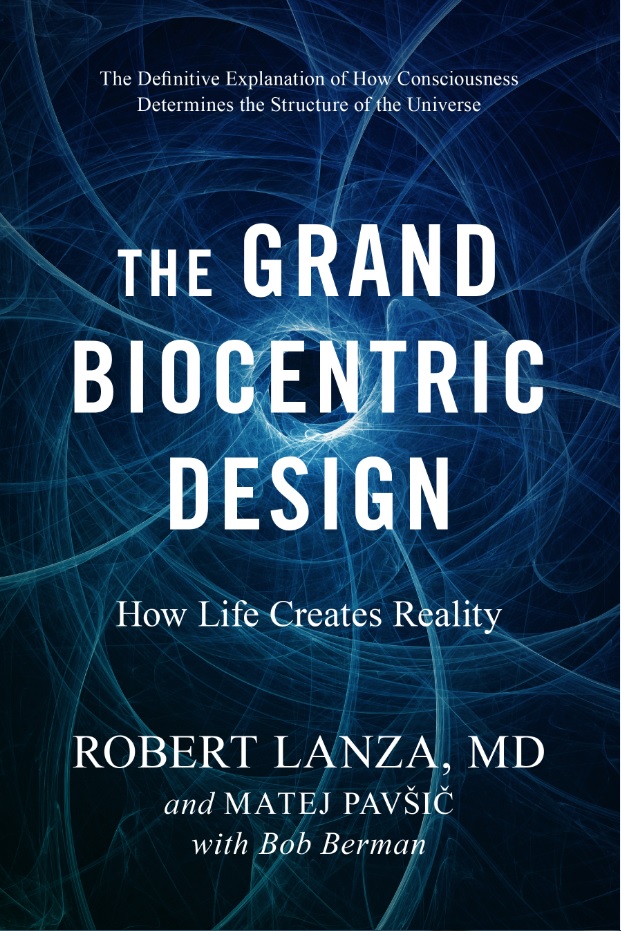
The Grand Biocentric Design: How Life Creates Reality
What is consciousness? Why are we here? Where did it all come from? Humans have been asking these questions forever, but science hasn't succeeded in providing many answers – until now. In The Grand Biocentric Design, Robert Lanza, one of Time Magazine's "100 Most Influential People," is joined by theoretical physicist Matej Pavsic to shed light on the big picture that has long eluded philosophers and scientists alike.
"quite thrilling ... its notions are exciting ones, and they do a sound job of linking them to observable, replicable experiments. Fans of revolutionary science—or just big, cerebral questions—will enjoy this ambitious work. A thought-provoking dispatch from the frontier of physics."
—Kirkus Reviews
"a masterpiece"
—Anthony Atala, W. Boyce Professor, Wake Forest University
"paradigm-shattering"
—Lucian Del Priore, Robert R. Young Professor, Yale University
"It's fabulous—I couldn't put it down!"
—Ralph Levinson, Professor Emeritus, UCLA
"Robert Lanza is one of the most creative and brilliant scientists I have ever known"
—Kwang-Soo Kim, Professor, Harvard University
