Are Dreams an Extension of Physical Reality

Are Dreams an Extension of Physical Reality?

We dismiss dreams because they end when we wake up. But whether awake or dreaming, you’re experiencing the same bio-physical process.

You spend a third of your life sleeping. What if your dreams are real? Perhaps our dismissal of dreams as “just dreams” is based on a misunderstanding of the nature of consciousness and physical reality.

“I am real” said Alice (in Wonderland). “If I wasn’t real, I shouldn’t be able to cry.”

“I hope you don’t suppose those are real tears?” Tweedledum interrupted in a tone of great contempt.

We take for granted how our mind puts everything together. Everything we experience is a whirl of information occurring in our heads. Biocentrism — a new “theory of everything” — tells us that space and time aren’t the hard objects we think, but rather tools our mind uses to put everything together. They’re the key to consciousness, and why in experiments with particles, space and time — and indeed the properties of matter itself — are relative to the observer. During both dreams and waking hours, your mind collapses probability waves to generate a physical reality, replete with a functioning body. You’re able to think and experience sensations in a 3D world.

We dismiss dreams because they end when we wake up. However, the duration of the experience doesn’t mean it has any less basis in physical reality. Certainly we don’t think day-to-day life is less real because we fall asleep or die. It’s true we don’t remember events in our dreams as well as in waking hours, but the fact that Alzheimer’s patients may have little memory of events doesn’t mean their life is any less real. Or that individuals who take psychedelic drugs don’t experience physical reality, even if the spatio-temporal events they experience are distorted or they don’t remember all of the events when the drugs wear off (certainly, anyone they had sex with would confirm this).

We also dismiss dreams as unreal because they’re associated with brain activity during sleep. But are our waking hours unreal because they’re associated with the neural activity in our brain? Certainly, the bio-physical logic of consciousness — whether during a dream or waking hours — can always be traced backwards, whether to neurons or the Big Bang. But according to biocentrism, reality is a process that involves our consciousness.

In contrast to dreams, we assume the everyday world is just “out there” and that we play no role in its appearance. We think they’re different. Yet experiments show just the opposite: day-to-day reality is no more objective or observer-independent than dreams. The most vivid illustration of this is the famous two-hole experiment. When you watch a particle go through the holes, it behaves like a bullet, passing through one hole or the other. But if no one observes the particle, it exhibits the behavior of a wave and can pass through both holes at the same time. This and other experiments tell us that unobserved particles exist only as waves of probability.

Critics claim this behavior is limited to the microscopic world. But this “two-world” view (that is, one set of physical laws for small objects, and another for the rest of the universe) has no basis in reason and is being challenged in labs around the world. Last year (Nature 459, 683, 2009), researchers showed that quantum behavior extends into the everyday realm. Pairs of vibrating ions were coaxed to entangle so their physical properties remained bound together when separated by large distances (“spooky action at a distance,” as Einstein put it). “Such situations are not observed in nature,” stated the authors. “This may be simply due to our inability to sufficiently isolate the system of interest from the surrounding environment — a technical limitation.” Other experiments with huge molecules called “Buckyballs” also show that quantum reality extends beyond the microscopic world. And in 2005, KHC03 crystals exhibited entanglement ridges one-half inch high, quantum behavior nudging into the ordinary world of human-scale objects.

Whether awake or dreaming, you’re experiencing the same bio-physical process. True, they’re qualitatively different realities, but if you’re thinking and feeling, it’s real. Thus, René Descartes’ famous statement Cogito, ergo sum (“I think, therefore I am”).

Further Reading

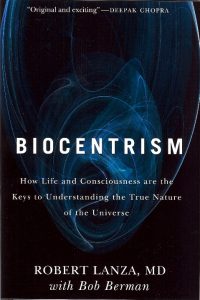
Biocentrism
Biocentrism: How Life and Consciousness are the Keys to Understanding the True Nature of the Universe

Biocentrism takes you on a seemingly improbable but ultimately inescapable journey through a foreign universe‒our own‒from the viewpoints of an acclaimed biologist and a leading astronomer. It will shatter your ideas of life-time and space, and even death…you will never see reality the same again.

"Like "A Brief History of Time" it is indeed stimulating and brings biology into the whole. Any short statement does not do justice to such a scholarly work… Most importantly, it makes you think."
Nobel Prize Winner E. Donnall Thomas

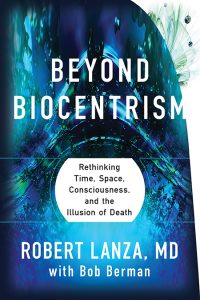
Beyond Biocentrism
Beyond Biocentrism: Rethinking Time, Space, Consciousness, and the Illusion of Death

"Beyond Biocentrism is an enlightening and fascinating journey that will forever alter your understanding of your own existence."
Deepak Chopra

"Beyond Biocentrism is a joyride through the history of science and cutting-edge physics, all with a very serious purpose: to find the long-overlooked connection between the conscious self and the universe around us."
Corey Powell, ex editor-in-chief, Discover magazine

"Will machines ever achieve consciousness? Are plants aware? Is death an illusion? These are some of the big questions tackled in Beyond Biocentrism, which serves up a new, biology-based theory of everything that is as delightful to read as it is fascinating."
Pamela Weintraub, ex editor-in-chief of OMNI Magazine
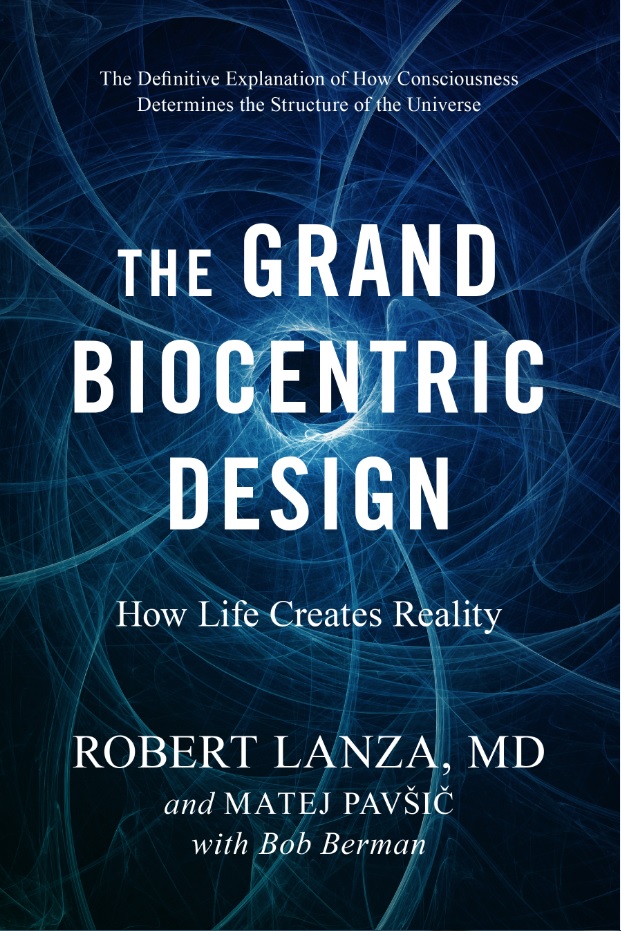
The Grand Biocentric Design
The Grand Biocentric Design: How Life Creates Reality

What is consciousness? Why are we here? Where did it all come from? Humans have been asking these questions forever, but science hasn't succeeded in providing many answers – until now. In The Grand Biocentric Design, Robert Lanza, one of Time Magazine's "100 Most Influential People," is joined by theoretical physicist Matej Pavsic to shed light on the big picture that has long eluded philosophers and scientists alike.

"quite thrilling ... its notions are exciting ones, and they do a sound job of linking them to observable, replicable experiments. Fans of revolutionary science—or just big, cerebral questions—will enjoy this ambitious work. A thought-provoking dispatch from the frontier of physics."
Kirkus Reviews

"a masterpiece"
Anthony Atala, W. Boyce Professor, Wake Forest University

"paradigm-shattering"
Lucian Del Priore, Robert R. Young Professor, Yale University

"It's fabulous—I couldn't put it down!"
Ralph Levinson, Professor Emeritus, UCLA

"Robert Lanza is one of the most creative and brilliant scientists I have ever known"
Kwang-Soo Kim, Professor, Harvard University

Scroll to Top