
Interview with Barbara Walters
Tapping Into the Code of Life With Science
By FARNAZ JAVID
March 28, 2008, 11:10 AM
In the 20th century, human life expectancy grew by 30 years, according to scientists.
That’s the biggest life span boost, greater than in the previous 5,000 years combined. In part we have medical breakthroughs like penicillin and vaccines to thank. Another huge factor is that childbirth became much safer.
Robert Lanza, the chief scientific officer of Advanced Cell Technology in Worcester, Mass., believes further advancements in health and science will continue that pattern through the 21st century and beyond.
“We’re really on the beginning of a new medical revolution. I think with new technologies — going in and using the stem cells that we were starting to develop — you could prolong lives to several hundred years,” said Lanza.
Cloning and Telomeres
Lanza is one of the world’s top cloning specialists and the first to clone endangered animals. He copied a gaur and a banteng — both breeds of rare oxen — obtaining their DNA from body parts that had been frozen for 20 years. After cloning herds of cows and comparing their DNA, Lanza studied their telomeres, a vital component to understanding aging in all living things.
“Telomeres are the body’s aging clock,” said Lanza. “The genetic makeup in our body consists basically of strands of DNA. Sort of like a shoestring. And at the end of these strands of DNA, there are these caps, the telomeres. So the telomeres get shorter and shorter every time the cell divides, until they get to a critical shortness, and the cell becomes old and decrepit and it dies.”
He discovered the telomeres of the cows he cloned were longer than their biological parents’ — helping those cells live 50 percent longer. That meant they could live to be the oldest herd of cows on the planet. If this were applied to humans, we could potentially live to 180.
Lanza has no plans to try cloning entire human beings, but the discovery is an important piece of the puzzle of why our cells age.
“There’s a consensus in the scientific community that it’s wrong and scientifically unsafe to use this technology for reproductive purposes. Our goal is to basically clone cells in a petri dish so that we can create replacement parts for the body, to repair damaged tissue.”
Stem Cells and Tissue Engineering
Lanza, also an expert in stem cell research, has successfully treated injured animals using embryonic stem cells grown in his laboratory.
“We’ve developed a technique where you can just take one cell, create these embryonic stem cells and not harm the embryo in any way,” said Lanza. “There’s a new discovery that was just reported that we can actually take a skin cell, or even a cheek swab, and just turn it into stem cells directly in the laboratory.”
Unlike embryonic stem cells, stem cells in adults are predetermined to grow into cells for certain parts of the body. No human embryos are harmed in the course of collecting stem cells.
“The adult body has stem cells in all of your tissues. We can get stem cells from fat, we can get them from your brain [and] we can get them from your skin. Throughout our body right now, we have stem cells that are repairing all of your vessels; they’re repairing tissue in your brain. That’s how you stay healthy. As you get older and cells die off, you need to replace them with new cells.”
For Lanza, embryonic stem cells are a solution to science because they are multipurpose in answering calls from all parts of the body.
“These are the body’s master cells,” said Lanza. “They’re actually immortal. They grow forever. And we can turn them into virtually every cell in your body.”
He sees the strong potential of stem cells in treating people suffering from Parkinson’s, Alzheimer’s disease, diabetes, atherosclerosis and strokes. He’s even on the verge of research that could eliminate the need for blood donations.
“We’re actually now able to grow an entire tube of blood cells from scratch from embryonic stem cells. And the beautiful thing about that is, if you start with one of the lines that’s O negative, it’s universal. It’ll match everybody. So you won’t have to worry about tissue typing.”
And for Lanza, the potential of the research doesn’t stop there but extends to creating organs.
“We can actually grow these up by the billions,” he said. “So we can create, say for instance, an entire heart [or kidney] some day. And some day, if you get into an auto accident, we’ll just take a skin cell and grow you up a new kidney.
“And it’s not science fiction,” he added. “We’re doing this today. We’ve already grown up entire bladders that are in people.”
Further Reading
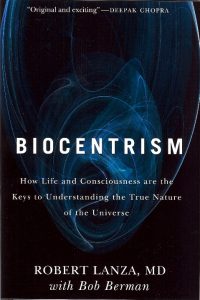
Biocentrism: How Life and Consciousness are the Keys to Understanding the True Nature of the Universe
Biocentrism takes you on a seemingly improbable but ultimately inescapable journey through a foreign universe‒our own‒from the viewpoints of an acclaimed biologist and a leading astronomer. It will shatter your ideas of life-time and space, and even death…you will never see reality the same again.
"Like "A Brief History of Time" it is indeed stimulating and brings biology into the whole. Any short statement does not do justice to such a scholarly work… Most importantly, it makes you think."
—Nobel Prize Winner E. Donnall Thomas
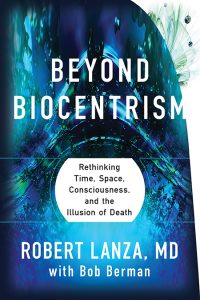
Beyond Biocentrism: Rethinking Time, Space, Consciousness, and the Illusion of Death
"Beyond Biocentrism is an enlightening and fascinating journey that will forever alter your understanding of your own existence."
—Deepak Chopra
"Beyond Biocentrism is a joyride through the history of science and cutting-edge physics, all with a very serious purpose: to find the long-overlooked connection between the conscious self and the universe around us."
—Corey Powell, ex editor-in-chief, Discover magazine
"Will machines ever achieve consciousness? Are plants aware? Is death an illusion? These are some of the big questions tackled in Beyond Biocentrism, which serves up a new, biology-based theory of everything that is as delightful to read as it is fascinating."
—Pamela Weintraub, ex editor-in-chief of OMNI Magazine
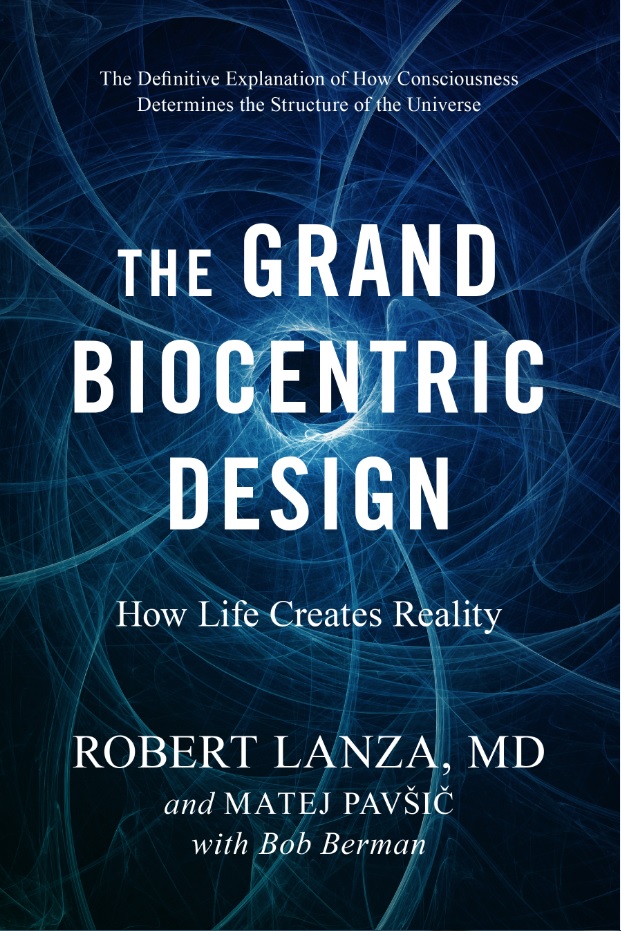
The Grand Biocentric Design: How Life Creates Reality
What is consciousness? Why are we here? Where did it all come from? Humans have been asking these questions forever, but science hasn't succeeded in providing many answers – until now. In The Grand Biocentric Design, Robert Lanza, one of Time Magazine's "100 Most Influential People," is joined by theoretical physicist Matej Pavsic to shed light on the big picture that has long eluded philosophers and scientists alike.
"quite thrilling ... its notions are exciting ones, and they do a sound job of linking them to observable, replicable experiments. Fans of revolutionary science—or just big, cerebral questions—will enjoy this ambitious work. A thought-provoking dispatch from the frontier of physics."
—Kirkus Reviews
"a masterpiece"
—Anthony Atala, W. Boyce Professor, Wake Forest University
"paradigm-shattering"
—Lucian Del Priore, Robert R. Young Professor, Yale University
"It's fabulous—I couldn't put it down!"
—Ralph Levinson, Professor Emeritus, UCLA
"Robert Lanza is one of the most creative and brilliant scientists I have ever known"
—Kwang-Soo Kim, Professor, Harvard University
