
Can Science Resurrect God

Can Science Resurrect God?

What happens if we project our current scientific knowledge into the future? A new scenario suggests the evolution of a new concept of God.

According to Nicholas Wade, veteran New York Times science reporter, and author of the new book The Faith Instinct, religious fervor has dwindled of late because religions have failed to keep pace with human knowledge. For faith to thrive, our concepts of God must adapt to our evolving scientific knowledge.

What happens if we project our current scientific knowledge into the future? A new scenario suggests the evolution of a new concept of God.

Imagine 100 years ago, looking up into the sky and seeing a pinhead in the stratosphere, and someone telling you the dot contained 400 people whizzing off to China faster than the chariots of the Greek gods. Or consider the progress with cloning; we now have the ability to resurrect species that no longer exist, such as the Bucardo mountain goat – and using chromosome transfer, we can create a mate for it just like God did for Adam in the Garden of Eden.

Now imagine what will be possible in 100 billion years.

While in medical school (working with heart-transplant pioneer Christiaan Barnard), I remember lifting the heart out of the chest of a dead man and putting it into another person to give him life. But all this is minor compared to everything we might ultimately experience. Science suggests it’s far beyond anything we have ever projected to any God. It’s only a short jump from quantum theory to the communion between the spiritual and extended worlds. One mainstream position states that there are an infinite number of universes, the ‘multiverse’. A new scientific theory – Biocentrism – suggests that time and space are not the hard objects we think, and that we will personally experience the totality of existence in the multiverse.

Science has only been around for a few hundred years (and quantum physics less than 100 years). At some point – perhaps in a thousand years, or maybe a million years of scientific evolution – we will completely master our understanding of spatio-temporal reality. We will be able to recreate information systems to generate any consciousness-based physical reality. In fact, according to Biocentrism, space and time have no absolute existence independent of these relationships.

You may even have the power to go back in time to end the world in a flood by simply modifying a specific spatio-temporal bubble. You could make a blind person see, or a crippled person walk. Indeed, my colleagues and I recently published experiments showing we could use stem cells to prevent blindness and to restore blood flow to limbs that might otherwise have required amputation.

As far-fetched as some of these projections seem, consider that even today – in our scientific infancy – we can clone organisms from a single cell or even a hair follicle. It doesn’t take much extrapolation to realize that at some point we will possess the knowledge to take a cell from, say, my friend Vicki’s mother, who was crippled from polio and died young, and resurrect her without the polio. And although I’m against human reproductive cloning, the science almost exists already – a few years ago we used cloning to resurrect a Banteng – an endangered ox-like animal – that had died over a quarter-of-a-century earlier from a broken back. It was surreal watching an Iowa cow give birth to an exotic creature that lives in the bamboo jungles of Southeast Asia (it’s now living happily with a herd of Bantengs at the San Diego Zoo).

A few days ago I attended my 35th high school reunion with Vicki, one of my oldest friends. Memories of her long-dead mother flashed across my mind as though they had occurred yesterday. Vicki’s mother was a kind, self-effacing woman. Her legs were in braces as the result of polio, and it was a struggle for her to bring out dessert when I visited. She was the mother I always wanted; she always joked that she was going to adopt me. Due to her disability she spent a lot of time watching TV, and was always watching those fake wrestling matches where they throw people around. We chuckled that this frail, gentle woman watched such shows. In fact, it is Vicki’s mom who inspired me after college to work with Jonas Salk who developed the polio vaccine (which has eradicated polio from the earth).

When I picked Vicki up, I knew her mom would have been thrilled to know that we were going to our 35th high school reunion together. If she had still been alive, she would have probably been watching wrestling, and told us some funny story to make us laugh before sending us on our way. How proud she would have been for both of us today (Vicki is now a successful lawyer, and I’m a doctor). It’s sad she never lived to see that. But in truth, she did see it somewhere in the multiverse. And it doesn’t matter how small the probability is, since all these histories are connected outside of time. What matters is that somewhere Vicki’s mom knows – whether you want to call it ‘heaven’ or not; no one has a monopoly on what heaven means and how it’s experienced. As hard as it is to fathom, somewhere outside of our limited linear thinking, Vicki and I will indeed get to visit her mom.

As we left for our reunion that night, somewhere Vicki’s mom leaned back on the sofa and watched the rest of the wrestling match with a smile on her face.

Further Reading

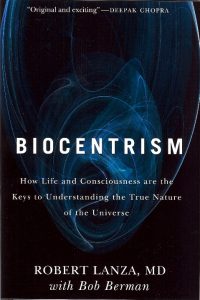
Biocentrism
Biocentrism: How Life and Consciousness are the Keys to Understanding the True Nature of the Universe

Biocentrism takes you on a seemingly improbable but ultimately inescapable journey through a foreign universe‒our own‒from the viewpoints of an acclaimed biologist and a leading astronomer. It will shatter your ideas of life-time and space, and even death…you will never see reality the same again.

"Like "A Brief History of Time" it is indeed stimulating and brings biology into the whole. Any short statement does not do justice to such a scholarly work… Most importantly, it makes you think."
—Nobel Prize Winner E. Donnall Thomas
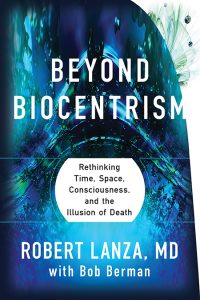
Beyond Biocentrism
Beyond Biocentrism: Rethinking Time, Space, Consciousness, and the Illusion of Death

"Beyond Biocentrism is an enlightening and fascinating journey that will forever alter your understanding of your own existence."
—Deepak Chopra

"Beyond Biocentrism is a joyride through the history of science and cutting-edge physics, all with a very serious purpose: to find the long-overlooked connection between the conscious self and the universe around us."
—Corey Powell, ex editor-in-chief, Discover magazine

"Will machines ever achieve consciousness? Are plants aware? Is death an illusion? These are some of the big questions tackled in Beyond Biocentrism, which serves up a new, biology-based theory of everything that is as delightful to read as it is fascinating."
—Pamela Weintraub, ex editor-in-chief of OMNI Magazine
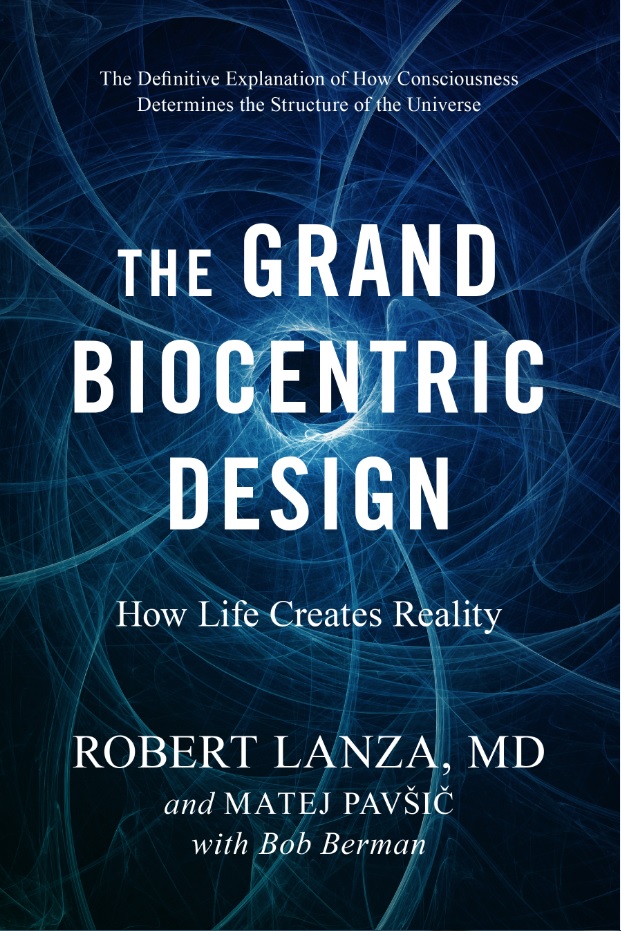
The Grand Biocentric Design
The Grand Biocentric Design: How Life Creates Reality

What is consciousness? Why are we here? Where did it all come from? Humans have been asking these questions forever, but science hasn't succeeded in providing many answers – until now. In The Grand Biocentric Design, Robert Lanza, one of Time Magazine's "100 Most Influential People," is joined by theoretical physicist Matej Pavsic to shed light on the big picture that has long eluded philosophers and scientists alike.

"quite thrilling ... its notions are exciting ones, and they do a sound job of linking them to observable, replicable experiments. Fans of revolutionary science—or just big, cerebral questions—will enjoy this ambitious work. A thought-provoking dispatch from the frontier of physics."
—Kirkus Reviews

"a masterpiece"
—Anthony Atala, W. Boyce Professor, Wake Forest University

"paradigm-shattering"
—Lucian Del Priore, Robert R. Young Professor, Yale University

"It's fabulous—I couldn't put it down!"
—Ralph Levinson, Professor Emeritus, UCLA

"Robert Lanza is one of the most creative and brilliant scientists I have ever known"
—Kwang-Soo Kim, Professor, Harvard University

Scroll to Top