If there is a beginning to this story, it began at the Salk Institute where I was finishing up some research with Dr. Jonas Salk. I was having my coffee when the letter came.
Harvard University
27 July 1978
Robert P. Lanza
c/o Dr. Jonas Salk
The Salk Institute
San Diego, California 92112
Dear Mr. Lanza:
I am sorry to be so slow in answering your letter, but I have been in some doubt about whether you would find it worthwhile spending the summer here.
I have no research funds and could not pay you anything. Nor do I have any considerable amount of space. A young colleague of mine will be conducting some experiments with operant equipment that might interest you, and I shall be working at the time on the third volume of my autobiography. Except for an occasional hot spell, Cambridge is a pleasant place to pass the summer, and I think you would find the few people here in this building interesting. There is usually a pleasant atmosphere and a great many exchanges of opinions.
If something of the sort interests you and I can tell you anything further, please let me know.
Yours sincerely,
B. F. Skinner
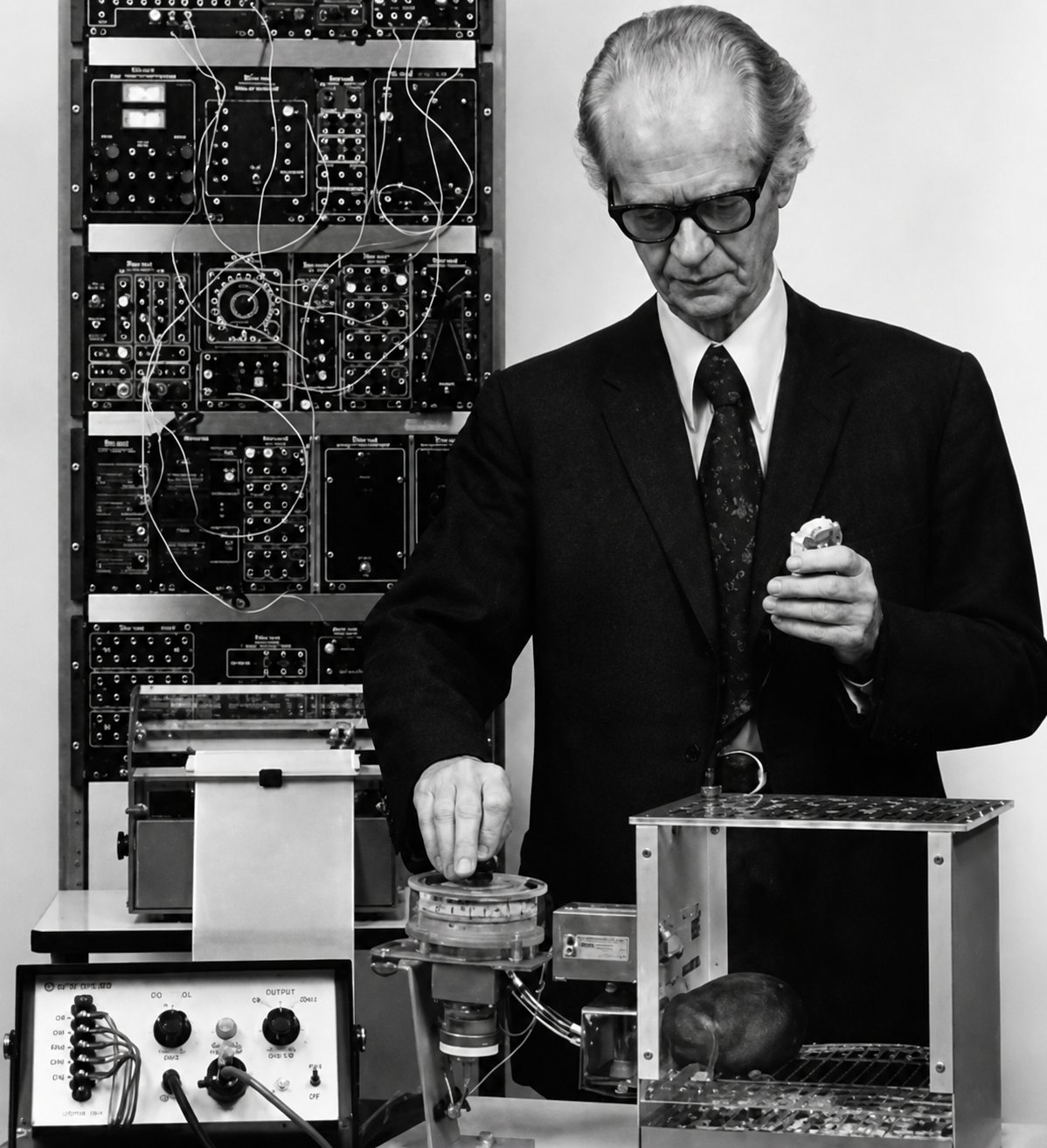
They were indeed an interesting group of people who worked in his building. The summer glided away, pleasantly enough, partly in exchanging opinions with B.F. Skinner, and partly in experiments in the laboratory, trying to demonstrate the qualitative similarities between humans and two white Carneaux pigeons named Jack and Jill. Fred was the only person besides his grad student who was working on the project. Skinner hadn’t done any research in nearly two decades-when he taught pigeons to dance with each other, and even to play Ping-Pong.
Our experiments eventually succeeded, and a couple of our papers appeared in Science. The media made a happy use of them with headlines such as “Pigeon Talk: A Triumph for Bird Brains” (Time magazine), “Ape-Talk: Two Ways to Skinner Bird” (Science News), “Birds Talk to B.F. Skinner” (Smithsonian), and “If You Were a Bird, What Would You Say?” (The Fiji Times). They were “fun” experiments, Fred explained on the “Today Show.”
I’ll admit it, working with Fred was one of the best times I ever had in my life. I even went to a pool party at his house. We eventually became good friends. Indeed, just before he died, I received a letter saying “Maggie was asking the other day about whether I had heard from you or what you were up to, and your card tells us that you are at least alive. Has anything else happened that is worth reporting to old friends? Greetings, Fred”
My work with Skinner was an auspicious beginning. Our experiments correlated well with Fred’s belief that the self is “a repertoire of behavior appropriate to a given set of contingencies.” However, in the years that have passed, I’ve come to believe that the questions can’t all be solved by a science of behavior. Indeed, a National Academy Report on Cognitive Science and Artificial Intelligence stated that the questions to which it concerned itself “reflect a single underlying great scientific mystery, on par with understanding the evolution of the universe, the origin of life, or the nature of elementary particles…”
What is consciousness? There’s a kind of blasphemy asking this question, a kind of personal betrayal to the memory of that gentle, yet proud old man who took me into his confidence so many years ago.
If only physicists, like Skinner, had respected the limits of their science. As the founder of modern behaviorism, Skinner didn’t attempt to understand the processes occurring within the individual; he had the reserve and prudence to consider the mind a black box. In one of our conversations about the nature of the universe, Skinner said, “I don’t know how you can think like that. I wouldn’t even know how to begin to think about the nature of space and time?” I saw in the softness of his glance the helplessness which as a great scientist the topic occasioned him.
These space and time; not neurons, not atoms, hold the answer to the problem of consciousness. In this age of science, we assume that the mind is totally controlled by physical laws. But there’s every reason to think that the observer who opens Schrödinger’s box, or who measures the electrons in the two-slit experiment, has a capacity greater than that of other physical objects. The difference lay, not so much in the gray matter of the brain, but in the way we perceive the world around us. How are we able to see things when in fact the brain is locked inside a sealed vault of bone? How does it turn electrochemical information into an order, a sequence and a unity? into this page? into something so real that very few people ever stop to ask how it happens, or to consider that these images are a construction hovering inside our head.
Somehow our mind elaborates sensations into perceptions, and those into conceptions and ideas. Now in this process, our thoughts have an order, not of themselves, but because the mind generates the spatio-temporal relationships involved in every experience. Time and space are the inner and outer forms of our sensuous intuition, respectively, the manifold which gives the world its order, meaning and sense.
It would be erroneous, therefore, to conceive of the mind as existing in space and time before this process, as existing in the circuitry of the brain before the understanding posits in it a spatio-temporal order. The situation is like that of playing a CD—when you turn the player on, the information leaps into 3D sound. In that way, and in that way only, does the music indeed exist.
Fred would have accused me of speculating about internal processes. But who amongst us isn’t thus guilty? Who amongst us hasn’t wondered at the powers and potentialities of life? of the human mind? whether the sources of nature and knowledge aren’t to be found in our own head?
Once, while driving past Mount Auburn Cemetery in Cambridge, Fred turned to me and said “You know, Rob, one day I’m going to be over there.” That was 30 years ago. What’s left of this great man is now marked by a small stone in the rolling terrain. It’s hard to drive by in the spring when the majestic trees are all in bloom. I miss him, but am comforted to know that Einstein was right when he said “Now Besso (an old friend) has departed from this strange world a little ahead of me. That means nothing. People like us … know that the distinction between past, present and future is only a stubbornly persistent illusion.”