

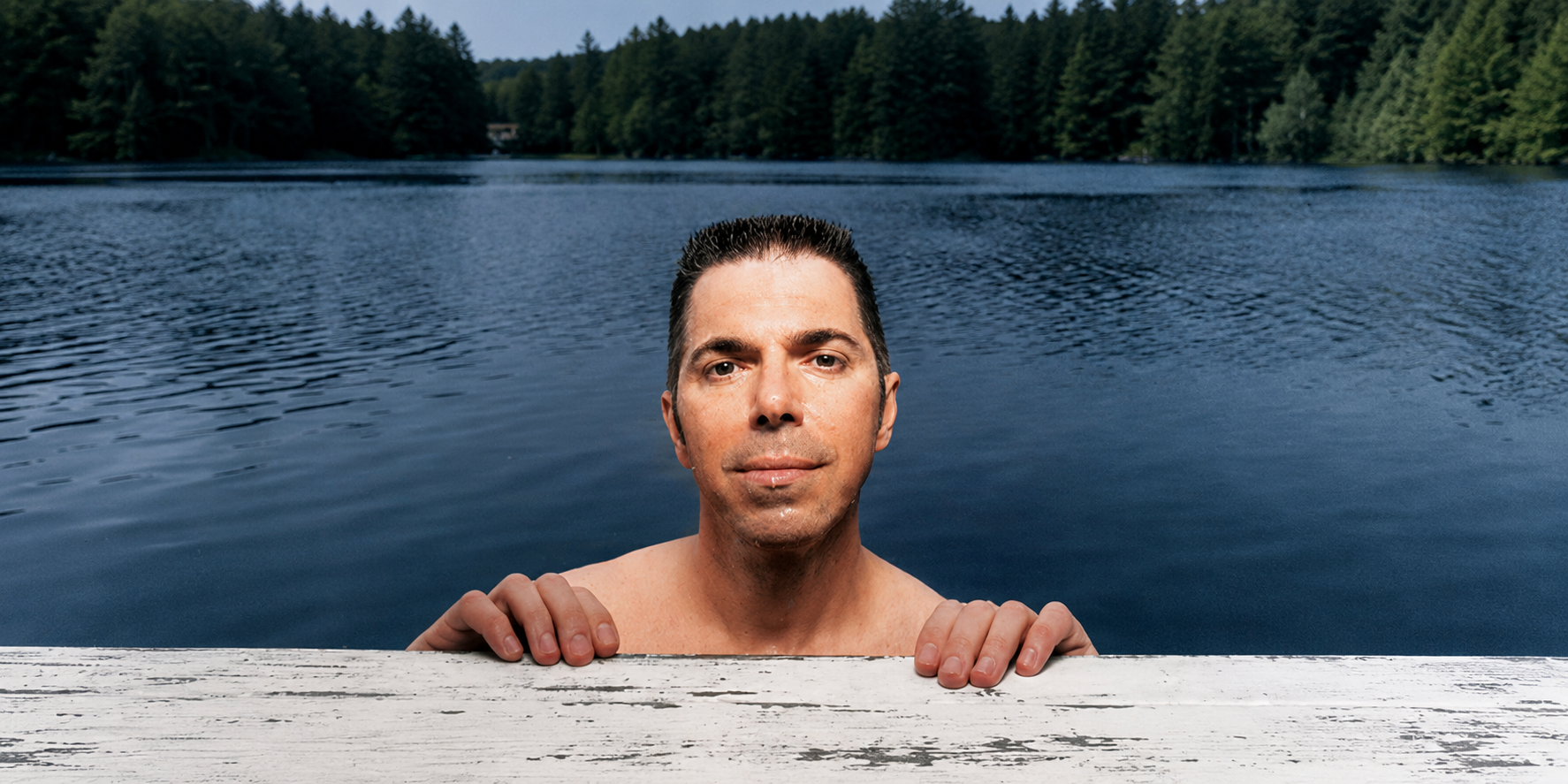
Discover Interview: Robert Lanza
by Pamela Weintraub; photography by Michael Lewis
From the September 2008 issue; published online August 19, 2008
Whether defying the dean of the University of Pennsylvania School of Medicine so he could publish a book on world health or challenging the titans of cosmology, Robert Lanza has never followed the script.
Excerpt from Interview
Obviously you didn’t go into surgery. What came next?
By the time I graduated from medical school, heart transplant surgery had become conventional, so I moved to Los Angeles and did something I’ve never told anyone else about: I spent a couple of years rolling pennies and eating canned spinach and pasta while I tried to understand the universe, an effort I felt had reached a dead end.
Dropping everything to spend years thinking about cosmology could be called self-indulgent.
For me it was the equivalent of hiking around Europe—I was hiking through the universe, and I needed the intellectual freedom to just think. I’ll tell you, putting the puzzle together is not trivial, but after two years I had a new theory of the universe.
Your book on that work, called Biocentrism, cowritten with the astronomer Bob Berman, will be out soon. In it you propose that our current theories of the universe will never work unless they account for life and consciousness. Can you explain?
Look at this coffee cup. You say it’s right there, but the truth of the matter is you can’t see that through your brain. Your brain has a bone around it. What is happening is that what you see is reconstructed in your mind. We have these words space and time, but you can’t touch them. They’re not objects, they’re not things, they go forever. Space and time are really tools of animal sense perception, the way we organize and construct information.
You have suggested that reality is determined by the conscious observer. Most physicists view consciousness as an accident.
There was a paper published in Science this February, and what it showed was that if you do an experiment with a photon, put it in the apparatus, that what you do right now actually changes an event that already occurred in the past. Now isn’t that bizarre? That is the same universe that you and I are in. How can the physics in this experiment actually show that if you do something right now it retroactively changes an event that has already happened? You can play your little games with it, but any way you cut the pie, if you observe something it acts as a particle, and if you don’t it acts as a wave. It is not an artifact of the system. Those experiments are real. Get over it.
You’ve said physical laws are exactly balanced for life to exist.
If there were one-billionth of a difference in the mass of the Big Bang, you couldn’t have galaxies. If the gravitational constant were ever-so-slightly different, you couldn’t have stars, including the sun, and you would just have hydrogen. There are 200 parameters like this. We now have people out there talking about an intelligent design, saying “God” is the explanation. But it is really because quantum theory is right: Everything is observer-determined and the past and present are relative only to you, as the observer. It all fits, but the problem is, you then do need to accept what people will not accept: When you turn your back to the moon, it no longer exists.
Further Reading
Biocentrism: How Life and Consciousness are the Keys to Understanding the True Nature of the Universe
Biocentrism takes you on a seemingly improbable but ultimately inescapable journey through a foreign universe‒our own‒from the viewpoints of an acclaimed biologist and a leading astronomer. It will shatter your ideas of life-time and space, and even death…you will never see reality the same again.
"Like "A Brief History of Time" it is indeed stimulating and brings biology into the whole. Any short statement does not do justice to such a scholarly work… Most importantly, it makes you think."
—Nobel Prize Winner E. Donnall Thomas
Beyond Biocentrism: Rethinking Time, Space, Consciousness, and the Illusion of Death
"Beyond Biocentrism is an enlightening and fascinating journey that will forever alter your understanding of your own existence."
—Deepak Chopra
"Beyond Biocentrism is a joyride through the history of science and cutting-edge physics, all with a very serious purpose: to find the long-overlooked connection between the conscious self and the universe around us."
—Corey Powell, ex editor-in-chief, Discover magazine
"Will machines ever achieve consciousness? Are plants aware? Is death an illusion? These are some of the big questions tackled in Beyond Biocentrism, which serves up a new, biology-based theory of everything that is as delightful to read as it is fascinating."
—Pamela Weintraub, ex editor-in-chief of OMNI Magazine
The Grand Biocentric Design: How Life Creates Reality
What is consciousness? Why are we here? Where did it all come from? Humans have been asking these questions forever, but science hasn't succeeded in providing many answers – until now. In The Grand Biocentric Design, Robert Lanza, one of Time Magazine's "100 Most Influential People," is joined by theoretical physicist Matej Pavsic to shed light on the big picture that has long eluded philosophers and scientists alike.
"quite thrilling ... its notions are exciting ones, and they do a sound job of linking them to observable, replicable experiments. Fans of revolutionary science—or just big, cerebral questions—will enjoy this ambitious work. A thought-provoking dispatch from the frontier of physics."
—Kirkus Reviews
"a masterpiece"
—Anthony Atala, W. Boyce Professor, Wake Forest University
"paradigm-shattering"
—Lucian Del Priore, Robert R. Young Professor, Yale University
"It's fabulous—I couldn't put it down!"
—Ralph Levinson, Professor Emeritus, UCLA
"Robert Lanza is one of the most creative and brilliant scientists I have ever known"
—Kwang-Soo Kim, Professor, Harvard University
