
What Is Happiness?
Forget the self-help books. No book or person can promise you happiness.
Christmas time is the most likely time of the year to experience depression. We share our love with friends and family, and get lots of gifts. So why aren’t we all joyous? What the hell is going on?
Did you ever wonder why people like Elvis Presley and Michael Jackson didn’t fare any better than you or I despite all their money, fame, and access to people of wisdom?
The answer lies in your own backyard. Look at the shrubs, tangled with vines, with here and there a sumac jutting out from the maze. Look at the pines pressed against the shingles for want of more sunlight, their roots reaching under the house to the length of 20 feet. In an effort to maintain themselves, I have known willows near the foundation to break into the cellar pipes for want of water.
What is a tree, after all, but a trunk with so many roots and leaves bringing food and water to the organism? After billions of years of evolution, it was inevitable that life would acquire the ability to locomote, to hunt and see, to protect itself from competitors. Observe the ants in the woodpile. They can engage in combat just as resolutely as any human. Our guns and ICBMs are merely the jaws of a more clever ant.
The goal of life is life. Every impulse and thought is a device developed towards that end. Consider our own species. We hunt and gather, do the dishes, and have sex. By day and night, we are serenaded by the notes of Beethoven modulating over the trump of the bullfrogs and the songs of the mating bird. Even poetry and art reflect our humanity and are impelled by instincts – by forms of fear and powerlessness, of pugnacity and mastery, of association and love.
To many creatures there are but a few necessities of life: food, water, shelter. To a bumblebee, these are a few flowers full of nectar. Even humankind is led by these primary drives, although we have invented not only the house and clothing but fire to cook our food. What pains we take during the holidays, with our mincemeat pies and rum cakes. The poor are wont to complain that they have no food for their families, and we devote a great deal of our economy to agriculture and housing.
Of course, the effort for self-preservation is vague and varied. There is, for instance, the need for understanding and knowledge to guide our emotions, to tame the beast in our animal nature. What shameless and chaotic lives many of us would live if we were not awakened by better desires from within.
Our behavior is motivated by needs and wants. Pleasure and pain consist in the extent to which these desires are satisfied or hindered. “Pleasure” according to Spinoza, one of the greatest philosophers of all time “is man’s transition from a lesser state of perfection to a greater. Pain is man’s transition from a greater state of perfection to a lesser.”
Here is a goal – completeness and power – that is wonderfully attractive to us at a time of recession, and when many lack the means to feed and clothe themselves. And when we have found all power, we may not be happier for it. When we have overcome our struggles and have no ambitions and no defeats, what do we do next? Build taller and more splendid houses, weave finer clothing? Where does the power to act come from when desire has been quieted?
Have you ever wondered why every TV show, movie, and book has villains? Every writer knows that the good guy has to be threatened somehow, perhaps chased by someone with a gun or an ax. Even Cinderella had an evil stepmother and had to sit in the cinders after she finished her work. Meeting the Prince just wouldn’t have been the same if she had been a spoiled little rich girl.
The keenest pleasures are for those who experience the keenest pain.
You can’t change the equation of life. And remember, while the world is celebrating the holiday season, if you’re depressed and have the blues it’s just money in the bank. And when your turn comes, spend it on something that you will be proud of.
Further Reading
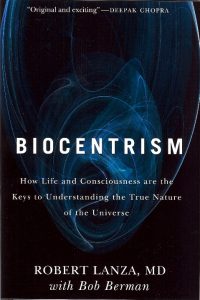
Biocentrism: How Life and Consciousness are the Keys to Understanding the True Nature of the Universe
Biocentrism takes you on a seemingly improbable but ultimately inescapable journey through a foreign universe‒our own‒from the viewpoints of an acclaimed biologist and a leading astronomer. It will shatter your ideas of life-time and space, and even death…you will never see reality the same again.
"Like "A Brief History of Time" it is indeed stimulating and brings biology into the whole. Any short statement does not do justice to such a scholarly work… Most importantly, it makes you think."
—Nobel Prize Winner E. Donnall Thomas
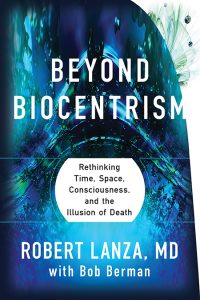
Beyond Biocentrism: Rethinking Time, Space, Consciousness, and the Illusion of Death
"Beyond Biocentrism is an enlightening and fascinating journey that will forever alter your understanding of your own existence."
—Deepak Chopra
"Beyond Biocentrism is a joyride through the history of science and cutting-edge physics, all with a very serious purpose: to find the long-overlooked connection between the conscious self and the universe around us."
—Corey Powell, ex editor-in-chief, Discover magazine
"Will machines ever achieve consciousness? Are plants aware? Is death an illusion? These are some of the big questions tackled in Beyond Biocentrism, which serves up a new, biology-based theory of everything that is as delightful to read as it is fascinating."
—Pamela Weintraub, ex editor-in-chief of OMNI Magazine
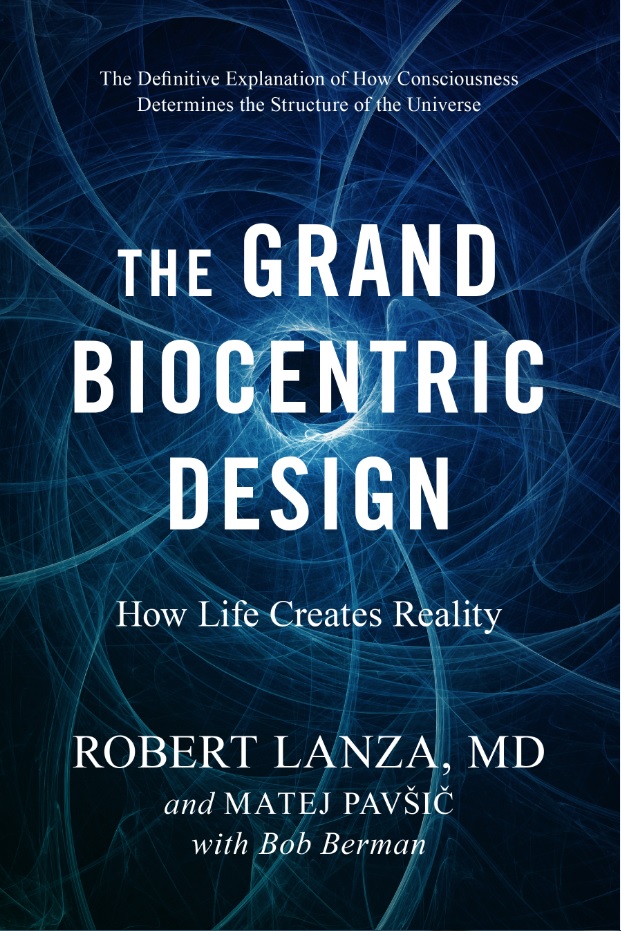
The Grand Biocentric Design: How Life Creates Reality
What is consciousness? Why are we here? Where did it all come from? Humans have been asking these questions forever, but science hasn't succeeded in providing many answers – until now. In The Grand Biocentric Design, Robert Lanza, one of Time Magazine's "100 Most Influential People," is joined by theoretical physicist Matej Pavsic to shed light on the big picture that has long eluded philosophers and scientists alike.
"quite thrilling ... its notions are exciting ones, and they do a sound job of linking them to observable, replicable experiments. Fans of revolutionary science—or just big, cerebral questions—will enjoy this ambitious work. A thought-provoking dispatch from the frontier of physics."
—Kirkus Reviews
"a masterpiece"
—Anthony Atala, W. Boyce Professor, Wake Forest University
"paradigm-shattering"
—Lucian Del Priore, Robert R. Young Professor, Yale University
"It's fabulous—I couldn't put it down!"
—Ralph Levinson, Professor Emeritus, UCLA
"Robert Lanza is one of the most creative and brilliant scientists I have ever known"
—Kwang-Soo Kim, Professor, Harvard University
